> ## Documentation Index
> Fetch the complete documentation index at: https://docs.shieldlabs.ai/llms.txt
> Use this file to discover all available pages before exploring further.
# Security
> Protect your ShieldLabs keys, webhooks and data in transit.
Securing a ShieldLabs integration comes down to four things: verify that every webhook really came from us, keep your server-side keys on the server, run everything over HTTPS, and know what protects the snippet's payload. This page is the reference for each.
These are integration security controls. ShieldLabs returns a Risk Score (`0-100`: Trusted / Suspicious / Dangerous) and its named risk signals on each identification; you choose the action for each case and act on the result in your backend.
## Webhook authenticity (HMAC-SHA256)
Your webhook URL is a public endpoint. Anyone who learns it can POST to it. The only thing that proves a delivery actually came from ShieldLabs is its signature, so **verify every webhook before you trust the body.** The signature is the `X-Shield-Signature` header: `sha256=` plus the hex HMAC-SHA256 (a keyed cryptographic hash that only someone holding the secret can produce) of the **raw request body**, keyed with that endpoint's `whsec_…` signing secret, constant-time compared, rejecting with `401` on a mismatch.
The exact formula, the Node, Go, and Python handlers, the raw-bytes gotcha, and idempotency on `request_id` all live on the [webhooks](/setup/webhooks) page.
## Key handling
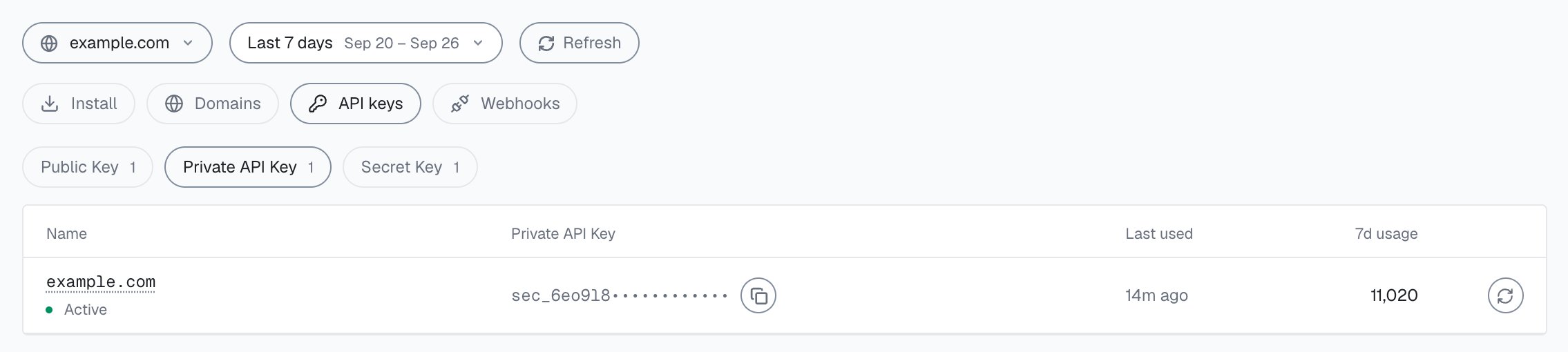
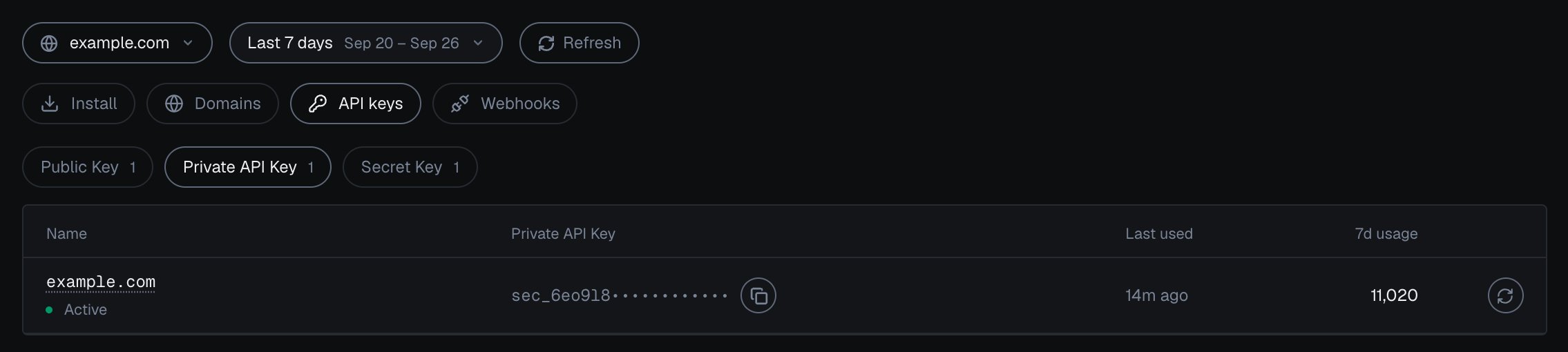
Every domain has a **Public Key**, a **Private API Key**, and a **Secret Key**, scoped to that single domain. They have different trust levels. The [API keys](/setup/keys) page is the full reference for which key each API uses.
| Key | Where it belongs | What it can do | Safe in the browser? |
| - | - | - | - |
| **Public Key** | The snippet URL on your site | Identifies the domain, so each identification is counted to the right site and account | Yes, by design |
| **Private API Key** | Your server only (`sec_…`) | Authenticates the [History API](/api/server-api) on `account.shieldlabs.ai` (`Authorization: Bearer`) | No, never |
| **Secret Key** | Your server only | Authenticates the [Management API](/api/server-api) on `api.shieldlabs.ai` (`Authorization: Bearer` + `X-Shield-Domain`) | No, never |
| **Webhook signing secret** | Your server only (`whsec_…` per endpoint) | Verifies the `X-Shield-Signature` header on incoming webhooks | No, never |
 The Public Key is meant to be visible. It ships in your page source as the `?publicKey=` parameter and cannot read data, change settings, or authenticate against the Server API. A browser request is accepted only when the Public Key matches the domain the page is served from (anything else gets `401` before it counts), so a key lifted from your page does not work on someone else's site. Scripted traffic that presents your domain typically shows up with automation risk signals, and you can rotate the key.
Your server-side keys (the Private API Key and the Secret Key) authenticate the Server API. **Anyone holding one can read your domain's data**, so they must never reach the browser. Webhook endpoints use separate `whsec_…` secrets; treat a leaked webhook secret the same way and use **Rotate secret** on the endpoint under **Integration > Webhooks** in the analytics dashboard.
Never put the Secret Key in client-side code, the snippet, a public repository, a build artifact, or any place a browser can reach. Store it in an environment variable or a secrets manager. Use a different key set for every domain so a leak is contained to one site.
### Rotate when exposed
If a secret may have leaked (a committed `.env`, a log line, an offboarded teammate), open **Integration > API keys** in the analytics dashboard and **Rotate** the exposed key right away. **Rotate** replaces only the key you select, and the previous value stops working immediately, so update the snippet (Public Key) or your server-side code (Private API Key or Secret Key) in the same change. The rotation flow and the profile health check live on the [API keys](/setup/keys) page, and [Integration](/dashboard/integration) describes the screen.
## Transport security (HTTPS / TLS)
Every ShieldLabs web endpoint is served over HTTPS.
* **ShieldLabs hosts** (`cdn.shieldlabs.ai`, `rest.shieldlabs.ai`, `webrtc.shieldlabs.ai`, `api.shieldlabs.ai`, `account.shieldlabs.ai`, `app.shieldlabs.ai`) are served over TLS (the encryption behind HTTPS). The snippet also connects to `wss://rest.shieldlabs.ai` and, for its network check, to `ice.shieldlabs.ai`; the [CSP](/setup/csp) page lists the exact directives.
* **Your webhook callback URL must be HTTPS.** It receives signed Risk Scores and identifiers, so terminate TLS in front of your handler.
* **Your Server API calls must be HTTPS.** They carry your server-side keys, so a plaintext request would put a credential on the wire. Always call over HTTPS (`https://account.shieldlabs.ai/…`, `https://api.shieldlabs.ai/…`).
The snippet requires a **secure context** (in practice, an HTTPS page, or `localhost` for local development). On an insecure `http://` page the snippet cannot run as intended. Serve any page that loads the snippet over HTTPS.
## Payload protection
The snippet posts to `rest.shieldlabs.ai` over HTTPS, and TLS keeps the payload confidential in transit. Each payload is also sealed with AES-256-GCM and bound to its request ID and a one-time server challenge, and a request ID that was already processed is refused (`409`).
There is nothing for you to configure. Keep every page that loads the snippet on HTTPS.
## Data handling on your side
A few practices keep the data you exchange with ShieldLabs clean.
* **Pass a hashed User HID, never a raw identifier.** Call `checkAuthenticatedUser` with a hashed or pseudonymous account id, not a real email or user id. The User HID is the account key: users, account-level risk and all four High-Risk Events are built on it. It comes back as `user_hid` in webhooks and History rows, so keep it opaque.
* **The Public Key is the only credential in the browser.** Identifiers like the Cookie ID and Session ID live client-side by design and break on storage clear. The durable Device ID and the Risk Score are derived server-side and reach you through verified webhooks and the [Server API](/api/server-api); the page never assembles them.
* **Keep raw signals server-side.** Read Risk Scores and risk signals from your verified webhook handler or the History API, and apply the allow / step up / review / block action in your backend.
The [privacy](/privacy) page covers what is and is not collected, and who controls retention.
## Responsible disclosure
If you find a security issue in ShieldLabs, report it privately to **[contact@shieldlabs.ai](mailto:contact@shieldlabs.ai)**. Please include enough detail to reproduce it, and give us a reasonable window to confirm and fix before any public disclosure. We do not pursue good-faith researchers who follow coordinated disclosure.
## Security checklist
Constant-time compare `X-Shield-Signature` against HMAC-SHA256 of the raw request body, keyed with the endpoint's `whsec_…` secret. Reject with `401` on a mismatch.
Secret Key in an environment variable or secrets manager, never in the browser. One key set per domain.
Rotate the exposed key the moment it may have leaked, then update the snippet and your server in the same change.
Snippet pages, your callback URL, and your Server API calls all over TLS. The snippet needs a secure context to run.
Send only a hashed or pseudonymous account id to `checkAuthenticatedUser`.
## Related pages
`X-Shield-Signature` verification in Node, Go, and Python, and idempotency on `request_id`.
The Public Key, Private API Key and Secret Key, which API each one opens, and rotation.
The exact `script-src` and `connect-src` directives the snippet needs.
What is and is not collected, and who controls retention.
This documentation is built and hosted on [Mintlify](https://mintlify.com), a developer documentation platform.
The Public Key is meant to be visible. It ships in your page source as the `?publicKey=` parameter and cannot read data, change settings, or authenticate against the Server API. A browser request is accepted only when the Public Key matches the domain the page is served from (anything else gets `401` before it counts), so a key lifted from your page does not work on someone else's site. Scripted traffic that presents your domain typically shows up with automation risk signals, and you can rotate the key.
Your server-side keys (the Private API Key and the Secret Key) authenticate the Server API. **Anyone holding one can read your domain's data**, so they must never reach the browser. Webhook endpoints use separate `whsec_…` secrets; treat a leaked webhook secret the same way and use **Rotate secret** on the endpoint under **Integration > Webhooks** in the analytics dashboard.
Never put the Secret Key in client-side code, the snippet, a public repository, a build artifact, or any place a browser can reach. Store it in an environment variable or a secrets manager. Use a different key set for every domain so a leak is contained to one site.
### Rotate when exposed
If a secret may have leaked (a committed `.env`, a log line, an offboarded teammate), open **Integration > API keys** in the analytics dashboard and **Rotate** the exposed key right away. **Rotate** replaces only the key you select, and the previous value stops working immediately, so update the snippet (Public Key) or your server-side code (Private API Key or Secret Key) in the same change. The rotation flow and the profile health check live on the [API keys](/setup/keys) page, and [Integration](/dashboard/integration) describes the screen.
## Transport security (HTTPS / TLS)
Every ShieldLabs web endpoint is served over HTTPS.
* **ShieldLabs hosts** (`cdn.shieldlabs.ai`, `rest.shieldlabs.ai`, `webrtc.shieldlabs.ai`, `api.shieldlabs.ai`, `account.shieldlabs.ai`, `app.shieldlabs.ai`) are served over TLS (the encryption behind HTTPS). The snippet also connects to `wss://rest.shieldlabs.ai` and, for its network check, to `ice.shieldlabs.ai`; the [CSP](/setup/csp) page lists the exact directives.
* **Your webhook callback URL must be HTTPS.** It receives signed Risk Scores and identifiers, so terminate TLS in front of your handler.
* **Your Server API calls must be HTTPS.** They carry your server-side keys, so a plaintext request would put a credential on the wire. Always call over HTTPS (`https://account.shieldlabs.ai/…`, `https://api.shieldlabs.ai/…`).
The snippet requires a **secure context** (in practice, an HTTPS page, or `localhost` for local development). On an insecure `http://` page the snippet cannot run as intended. Serve any page that loads the snippet over HTTPS.
## Payload protection
The snippet posts to `rest.shieldlabs.ai` over HTTPS, and TLS keeps the payload confidential in transit. Each payload is also sealed with AES-256-GCM and bound to its request ID and a one-time server challenge, and a request ID that was already processed is refused (`409`).
There is nothing for you to configure. Keep every page that loads the snippet on HTTPS.
## Data handling on your side
A few practices keep the data you exchange with ShieldLabs clean.
* **Pass a hashed User HID, never a raw identifier.** Call `checkAuthenticatedUser` with a hashed or pseudonymous account id, not a real email or user id. The User HID is the account key: users, account-level risk and all four High-Risk Events are built on it. It comes back as `user_hid` in webhooks and History rows, so keep it opaque.
* **The Public Key is the only credential in the browser.** Identifiers like the Cookie ID and Session ID live client-side by design and break on storage clear. The durable Device ID and the Risk Score are derived server-side and reach you through verified webhooks and the [Server API](/api/server-api); the page never assembles them.
* **Keep raw signals server-side.** Read Risk Scores and risk signals from your verified webhook handler or the History API, and apply the allow / step up / review / block action in your backend.
The [privacy](/privacy) page covers what is and is not collected, and who controls retention.
## Responsible disclosure
If you find a security issue in ShieldLabs, report it privately to **[contact@shieldlabs.ai](mailto:contact@shieldlabs.ai)**. Please include enough detail to reproduce it, and give us a reasonable window to confirm and fix before any public disclosure. We do not pursue good-faith researchers who follow coordinated disclosure.
## Security checklist
Constant-time compare `X-Shield-Signature` against HMAC-SHA256 of the raw request body, keyed with the endpoint's `whsec_…` secret. Reject with `401` on a mismatch.
Secret Key in an environment variable or secrets manager, never in the browser. One key set per domain.
Rotate the exposed key the moment it may have leaked, then update the snippet and your server in the same change.
Snippet pages, your callback URL, and your Server API calls all over TLS. The snippet needs a secure context to run.
Send only a hashed or pseudonymous account id to `checkAuthenticatedUser`.
## Related pages
`X-Shield-Signature` verification in Node, Go, and Python, and idempotency on `request_id`.
The Public Key, Private API Key and Secret Key, which API each one opens, and rotation.
The exact `script-src` and `connect-src` directives the snippet needs.
What is and is not collected, and who controls retention.
This documentation is built and hosted on [Mintlify](https://mintlify.com), a developer documentation platform.